Blog
How Cake Design Is Becoming a New Form of Storytelling
7 September 2026 · 8 min read
Tuba Geçkil made her first sculpted cake for her son's first birthday. She shaped it like his favourite toy car. He thought it was the real car, and tried to play with it.
She had no formal art training. She grew up in Eskişehir, in central Turkey, with two parents who painted as amateurs. Today she runs Red Rose Cake, with two shops in Istanbul, and her hyper-real cakes reached a global audience during the pandemic lockdowns.
Notice what the first cake was about.
It was not about the birthday. It was about the boy, and the one object he loved most that year. The occasion was only the reason to make it.
That is the shift this article is about.
1. The cake is no longer just the celebration
For most of its history, a cake stood for an event. A wedding. A birthday. A festival. You could swap one cake for another of the same kind and lose nothing, because the cake was a marker. It said something is happening today.
That is changing. More and more, the cake is commissioned around the person inside the occasion, not the occasion itself. The brief has moved from "a birthday cake for my daughter" to "something built around what she loves".
It is a small change in wording. It is a large change in what a cake has to do.
2. From symbol to personalisation
Cakes have always carried meaning. Ceremonial cakes and sweet breads have stood for abundance, fertility, marriage, status and hospitality across many cultures. The modern celebration cake did not arrive from cooking alone. It arrived from ritual.
So the new part is not that cakes mean something. Cakes always meant something.
The new part is who decides the meaning.
Before, the meaning came with the occasion, fixed and shared. A wedding cake meant what wedding cakes meant. Now the customer supplies the meaning, and it is specific to one person. The cake has gone from a public symbol to a private one.
3. When the customer became part of the design
Better tools helped. Fondant, modelling chocolate, edible printing and sharper equipment widened what a person can physically build out of sugar.
But tools do not explain the change on their own. Skilled decorators could already build remarkable things fifty years ago.
What changed is expectation. Customers now arrive assuming the cake will be about them. They ask for a hobby, a job, a pet, a private joke, a place that matters, a film they have watched thirty times. They bring fragments and expect the fragments to end up in the design.
The cake becomes something close to a condensed visual biography.
4. Pinterest, Instagram and YouTube changed the brief
The easy claim is that social media made cakes more creative. That is not quite right, and it undersells what happened.
Social media changed what customers know is possible. That changed what they ask for.
Pinterest taught people to arrive with a reference board. Instead of "make something nice", a customer can now specify colour, shape, mood, style and composition before the first conversation ends. Cake design moved toward visual specification.
Instagram turned the cake into a shareable object. A cake now has to work in three places at once: in the room, in a photograph, and in a feed. That rewards strong silhouettes, unusual shapes and finishes that photograph well.
It also creates a tension worth naming. If a cake has to perform for an audience that was never invited, who is it for? A cake built to be meaningful to one person and a cake built to be impressive to everyone else are not always the same cake. The best designers are quietly choosing between those two briefs on every job.
Short video made the process part of the story. On Reels and Shorts, people watch the carving, the piping, the painting, the reveal. The finished cake is no longer the whole product. This turns the cake designer into something of a maker and a broadcaster at the same time.
YouTube spread technique. Sculpting, fondant work, airbrushing, internal structure and realistic modelling are all teachable now without an apprenticeship. A baker in Coimbatore can learn a method popularised in London and reinterpret it for a customer in Coimbatore. That has produced a shared global vocabulary of cake design that did not exist twenty years ago.
5. The cake became a canvas
Five styles show the range of what the cake is now asked to do.
Vintage and Lambeth. Joseph Lambeth set out his over-piping method in a 1934 book, The Lambeth Method of Cake Decoration and Practical Pastries. It is built from layer upon layer of piped scrolls, swags, shells and string work — closer to baroque architecture than to icing. It peaked around the 1950s, then fondant pushed it aside for decades. It came back in the 2020s through social media, in bright colours and with a sense of humour the original never had.
That arc is worth sitting with. A near-forgotten 1930s technique returned because a video platform made it visible again, and a new generation used it to say something the 1930s never meant by it.
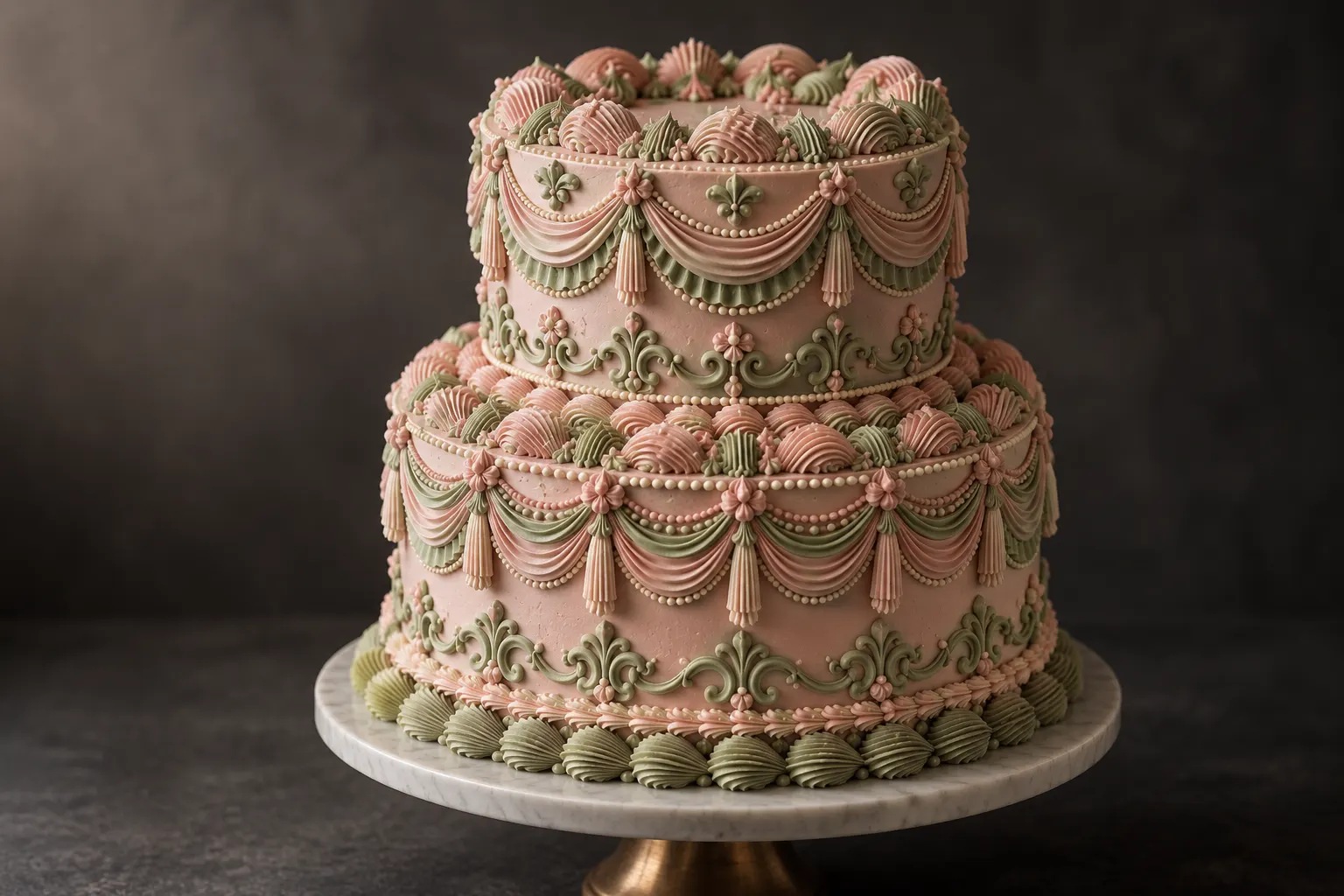 Illustration — Lambeth over-piping: swags, tassels and shell borders, built up layer on layer.
Sculpted cakes. Cars, handbags, animals, instruments, buildings. Here the cake stops carrying decoration and becomes the subject itself.
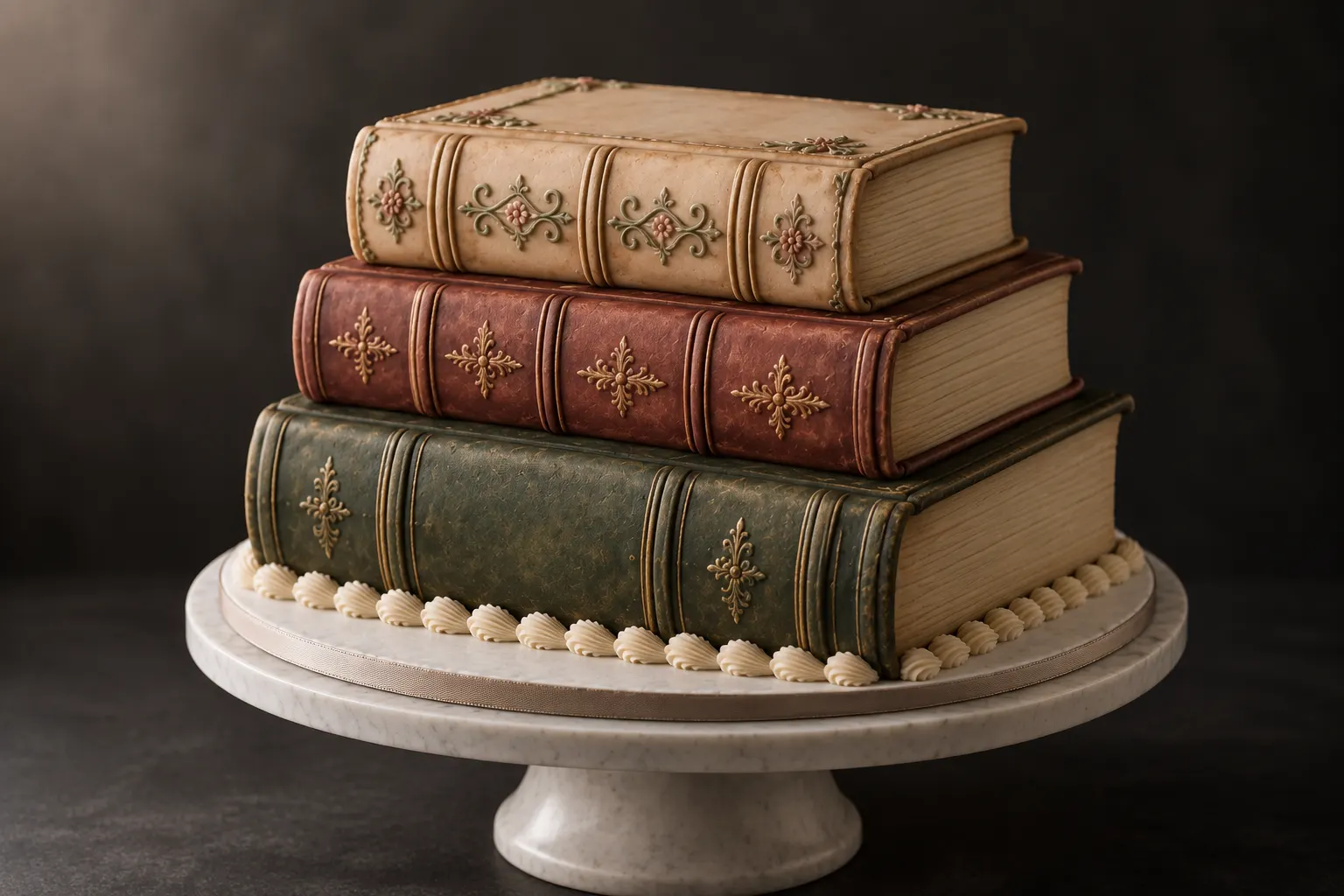 Illustration — The cake as object. The piped border at the base is what gives it away.
Hyper-realistic cakes. The point is the double take. In 2013 Natalie Sideserf sculpted a bust of Willie Nelson out of modelling chocolate, bandana and braids included, for a cake contest in Austin. It won, her brother posted it to Reddit, and it went to the top of the site. She and her husband both left their jobs and opened Sideserf Cake Studio on the back of it. The story of a hyper-real cake is surprise: the gap between what you see and what it is.
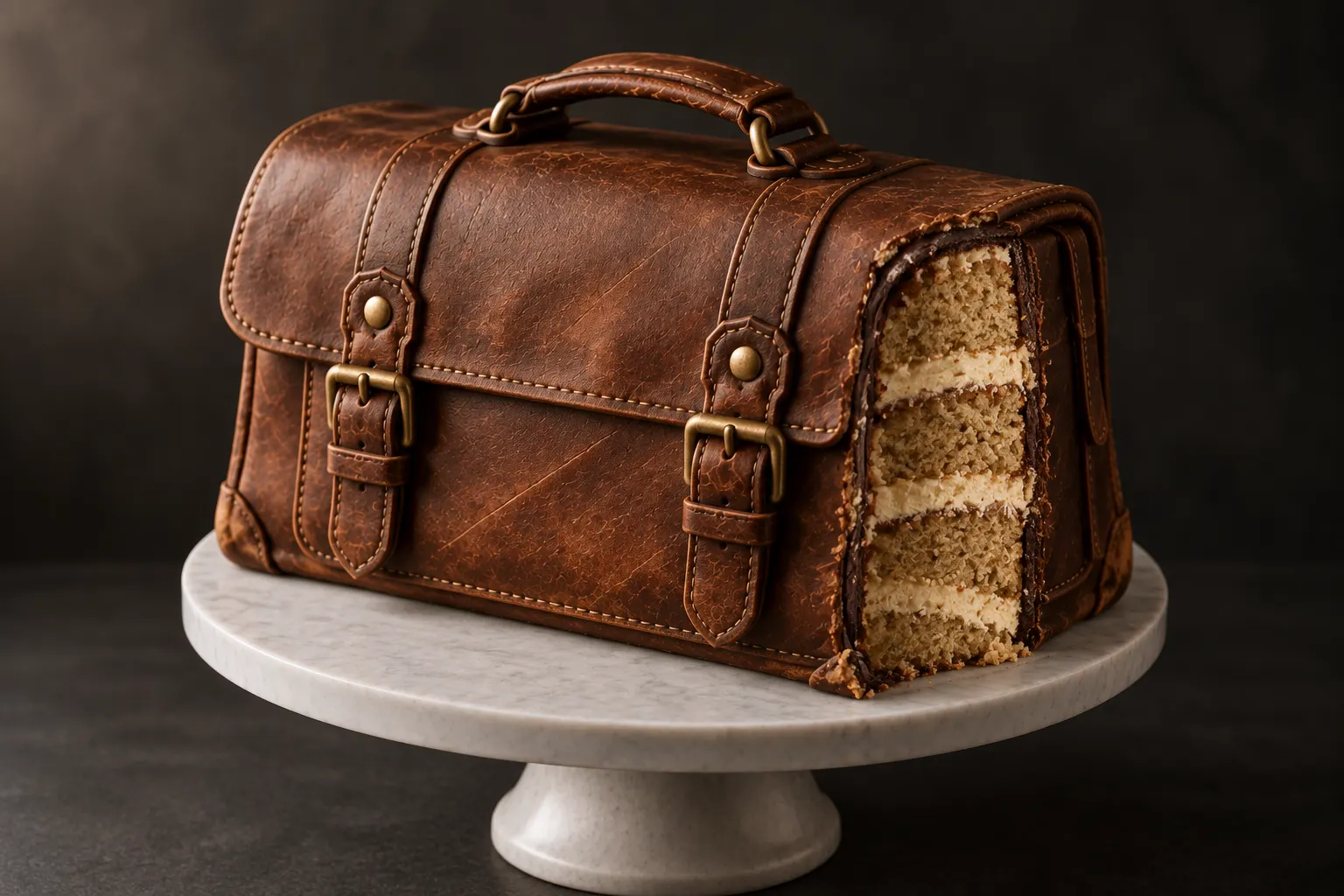 Illustration — The double take, and the moment it resolves. Not the cake described above.
Miniature scenes. Possibly the clearest storytelling of all. A family house. A workplace. A childhood street. A travel memory built at ten centimetres tall. The cake becomes a small three-dimensional scene of something that actually happened.
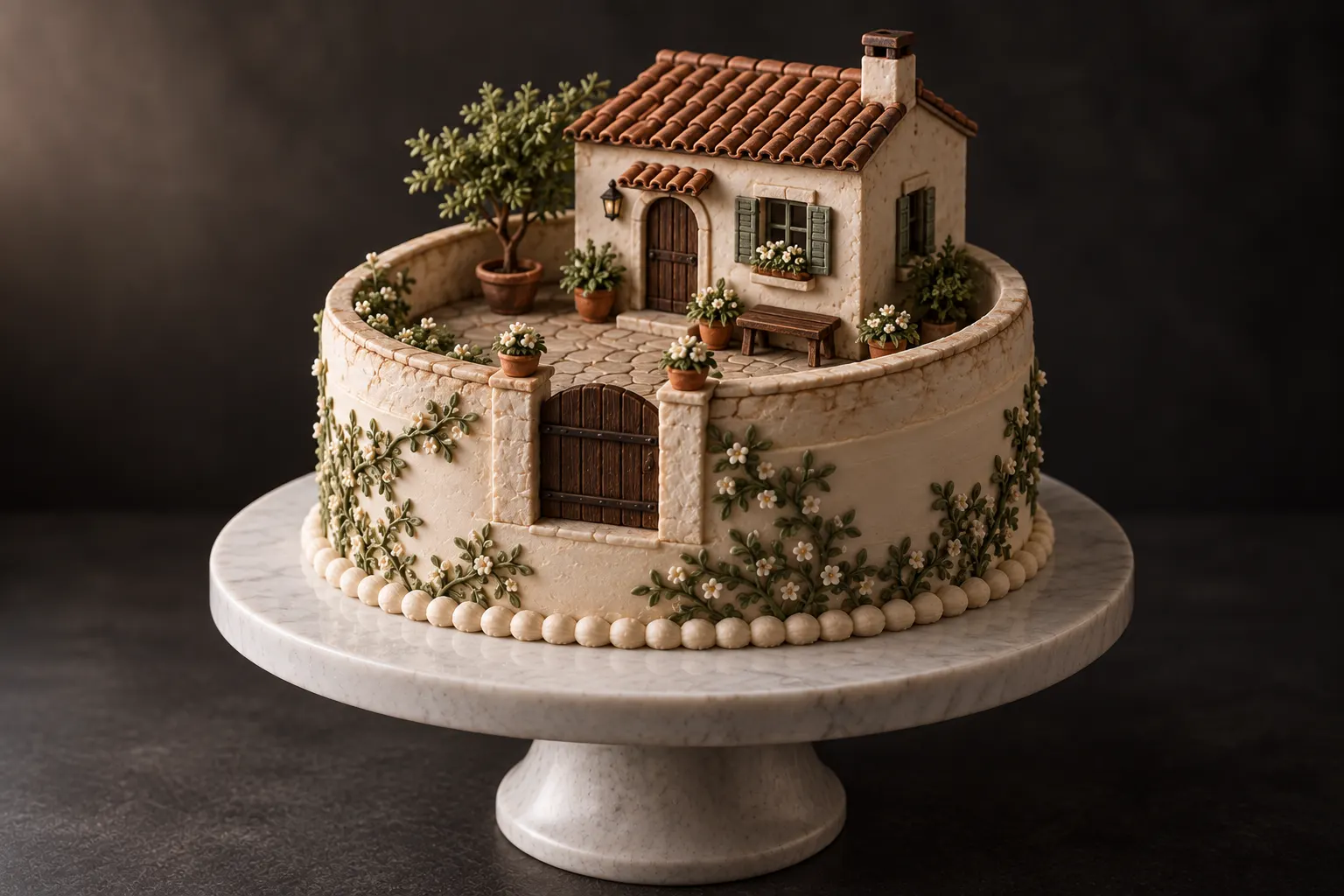 Illustration — A whole scene at doll's-house scale.
Character and fandom cakes. A character says "this is something I love", and love of a thing is a real part of how people describe themselves. Fandom is identity in shorthand.
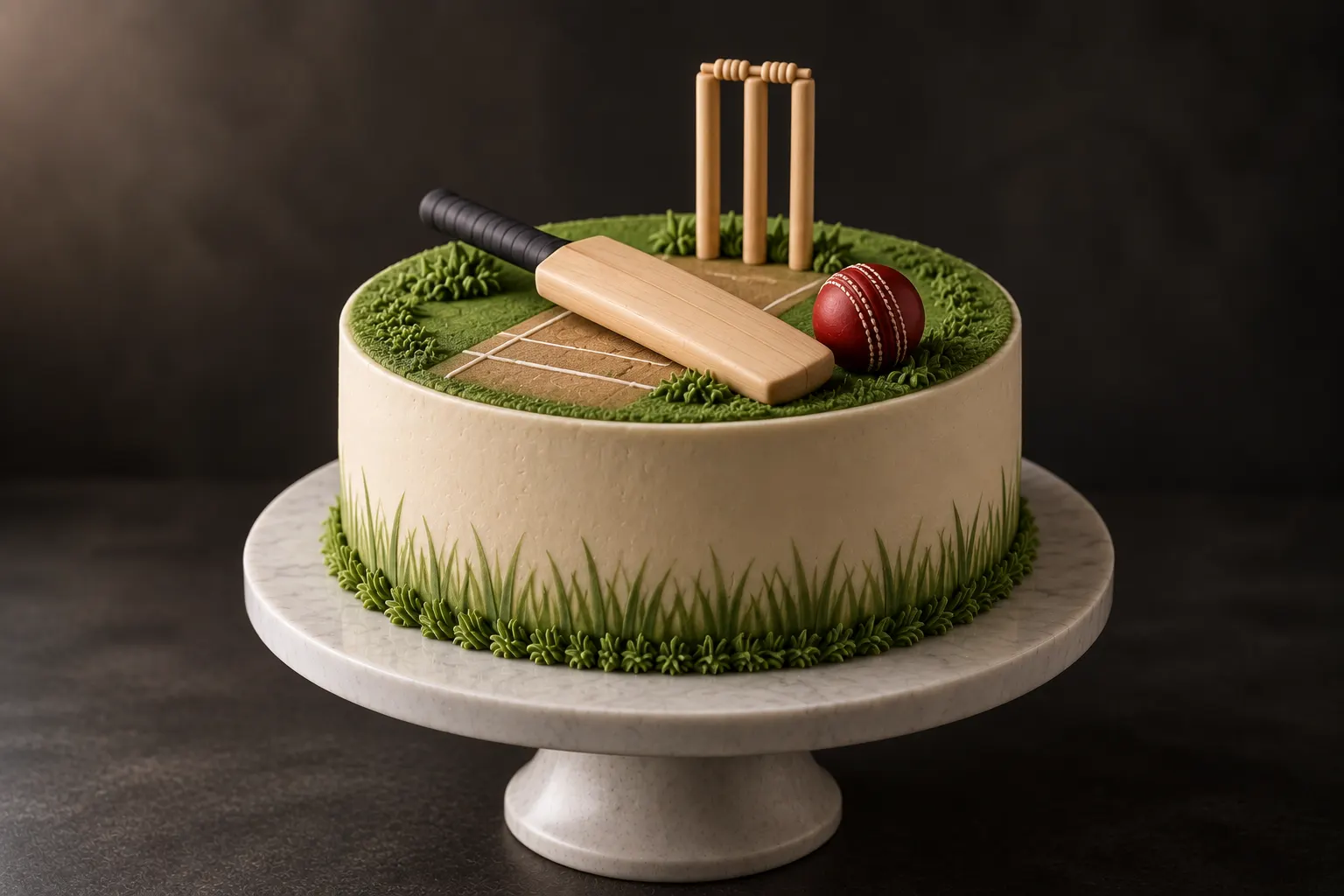 Illustration — fandom as shorthand. No team, no badge, and still unmistakable.
6. So what are people actually saying?
Across all of it, a handful of messages come up again and again.
- Personality — through colour, humour, and whether someone wants maximum or almost nothing.
- Memory — a childhood home, a family recipe, a school, a holiday.
- Relationship — couples, parents and children, friends, the joke only four people get.
- Work — the doctor, the architect, the pilot, the person who finally started the business.
- Obsession — the sport, the game, the band, the car, the books.
- Milestone — graduating, retiring, moving out, opening the shop.
- Identity — region, language, culture, faith, and where a person feels they are from.
The useful question about any of these cakes is not how hard was that to make. It is what is it saying.
7. The Indian cake landscape
India shows this shift clearly.
Research on the Indian cake market describes strong demand for photo cakes, character cakes for children, tiered wedding cakes and cakes carrying corporate branding. Personalisation is described as a major selling point rather than an upsell. Instagram and Pinterest are named directly as the platforms driving which designs people discover and then request.
One detail from that research matters more than any market number. Customers now expect to discuss the design itself over WhatsApp or an app, and to get updates while the cake is being made.
Read that again. The design conversation has become part of the product. The customer is not ordering a cake. They are commissioning one, and they expect to be present while it happens.
8. The cake designer as storyteller
This is the part that has changed most and is acknowledged least.
A customer rarely arrives with a design. They arrive with fragments. She loves her dog. They met while travelling. He is obsessed with cricket. It is their first anniversary.
None of those is a cake. Someone has to listen, work out which fragment carries the most weight, and turn it into something you can look at and understand in a second. That is interpretation, and it is the actual skill.
It makes the job less like baking and more like design. The person doing it is not only a maker. They are an interpreter.
Craft also has measurable value to customers. Puratos' Taste Tomorrow research, which surveys consumers across 50 countries, found that 64% of people globally agree that food that looks good is tasty too. It also found 24% are willing to pay more for products that showcase craftsmanship, and 16% would spend extra on visually stunning treats.
Design is not decoration on top of the product. For a growing share of customers, it is the product.
9. Where this goes next
It is tempting to assume the next stage is more spectacular. Taller, more realistic, harder to believe.
It may be the opposite.
The interesting direction is not more impressive cakes. It is more specific ones. A cake that only makes complete sense to about six people, because it is built out of things only those six know, is doing something a technically superior cake cannot.
A customer arrives with a story and no design. The baker has to hold the finished cake in their head, and the customer has to agree to something they cannot see yet. Almost everything that goes wrong in custom cake work goes wrong in that gap — rarely in the baking, which is the part the trade has already mastered.
So the useful question for the next few years is probably not how to make cakes more impressive. It is how two people who cannot see the same thing can agree on it before anyone turns on the oven.
The measure stops being look how creative cakes have become.
It becomes look at what people are using cakes to say.